

Anyone who studies firearms realize that the objective of any design is to safely contain the pressure generated by a cartridge and accurately deliver a projectile downrange. How this is done can be accomplished in a number of ways – just look at all the variations on rifling that have been tried, polygonal, Metford, Enfield, Paradox, etc. Human creativity is virtually unlimited when it comes to solving problems.
The same applies to the action and over time some designs became widely used and other ones occupy niches or disappear altogether. The Winchester self-loading series M1903, M1905, M1907 and M1910 is a good example of a design that has partially survived but most of which has become an evolutionary dead-end. This may seem counter-intuitive, since blowback actions are among the most popular ones in the world. However, this design is inherently self-limiting.
The WSL series of rifles are all straight blowback, in other words the only “locking” mechanism to contain the chamber pressure is the mass of the bolt that resists the rearward thrust from the cartridge head. We are all familiar with .22 rimfires and the myriad of models that use this design, however the energy level of a .22 long rifle is close to the upper limit of what is practical for this system.
The limiting issue with blowback designs is that the mass of the bolt needs to match the energy of the cartridge and a more powerful round means that the weight of the bolt goes up sharply. In addition, aside from the weight of the rifle, the slamming of a heavy bolt back and forth affects the perceived recoil as well.

What is apparent from the above table is that the 22 Win RF is about the same energy level as the .22 LR (130 ft/lbs) and it is chambered in a light handy rifle. Moving up to the M1905, either of the cartridges are under powered for any type of big game hunting, although the rifles are still great to carry and shoulder. Comparing the 32 WSL to the 32 Win Special or the 35 WSL to the 35 Remington shows how far they miss the mark, delivering only 40% of the energy of these classic deer cartridges.
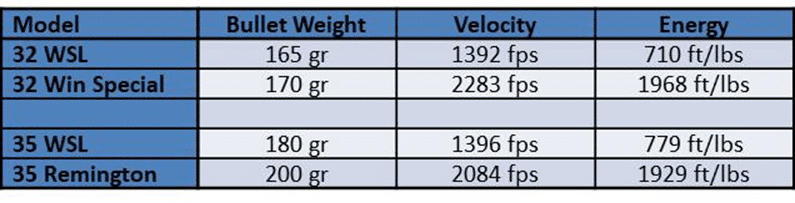

It is not until one reaches the 351 WSL, at 1400 ft/lbs, that it becomes a viable hunting option (using modern criteria) but even here it is a short-range round due to it curved trajectory. In fact the main buyers of 351 WSL rifles were not hunters but police and prison guards who were never going to be using them at any appreciable distance but, for whom rapid follow-up shots were important. Anyone who has picked up a M1907 knows that it is a substantial rifle and for the energy/range it provides, it is not going to be anyone’s first choice as a hunting rifle. By the time you get to the M1910, and its 401 WSL cartridge, which has the power and bullet weight to be an effective hunting round, the rifle was excessively heavy. Not only is the rifle chunky, the movement of the massive bolt makes shooting it seem like a work-out, with apparent recoil being much more than one would expect.
Reloading
Given the very limited sales of this gun family there has not been a lot of material published on them and the one exception is the softcover book, “The Forgotten Winchesters” by John Henwood (published 1995). If you like shooting this family of rifles and want to know more about them, find a used copy. While the book is plain looking, it provides a wealth of information on these Winchesters and is extremely well written.
I have had a bit of a love-hate relationship with the WSL rifles. I enjoy shooting them and in particular the .22 Auto. I was fortunate to have laid in a considerable supply of this rimfire ammo and the flat-nosed 45 gr bullet is a better killer than the .22 LR. However, the centrefire versions are a different story. With loads that match factory ammo, which is needed to ensure functioning, they kick cases a long way and do not expect them to be in a neat pile.
Getting brass for the centrefire cartridges may be expensive but fairly easy. Used brass, of varying quality/age shows up on auction sites and new brass is made by Bertram. One point to note is that it is important to know if the brass is turned from solid stock or if it is drawn like most modern cases. I came across some turned 401 brass a number of years ago and when I fired it with starting loads, the action cycled violently and the primer pockets had expanded enough that the primers fell out. I was lucky that I was not injured or the gun wrecked.
Powders are easy, there are lots that are fast burning that fit into the small case volume, with IMR 4227 (or H4227) being ideal. The one thing that can be an issue is the bullets.

With the exception of the 32 WSL, all the other rounds use odd diameter bullets, which are not readily available. Any bullet that will work in the 32-40 or 32 Special, will work for the 32 WSL. However, if jacketed bullets are used it is critical to be sure that factory velocities are matched to ensure that the bullet does not lodge in the barrel. For both the 32 and 35 WSL, it is best to use cast bullets, since they are less prone to sticking if a reduced load is used.
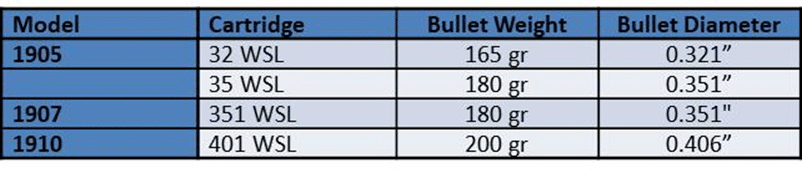 Grafs periodically has plated bullets for the 35/351 WSL but they have no crimping groove, which is not ideal. Commercial sources for the 401 WSL are even more limited. Barnes made jacketed bullets for the 401 WSL for a number of years but discontinued them. We do carry cast bullets for this family, for those who do not want to cast their own. Since these guns are all straight blowback there is no gas port or system that can be fouled by lead, so using cast bullets is feasible. Even with the 401 WSL, cast bullets will not foul the barrel if they are cast hard and well lubed. In fact, staying with cast bullets for this whole family is the best overall option.
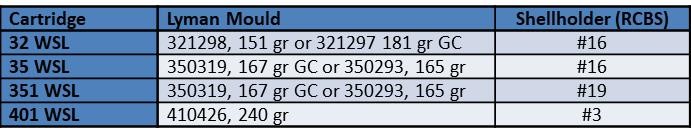
In terms of cast bullets that are suitable, Lyman used to make quite a number that are now discontinued moulds. However, if you are at a gun show, keep your eye out for the following. I have included the RCBS shellholder that works best for Bertram brass.
The table below shows loads that are below maximum listed ones and which I have shot in my rifles. That is not to say that they will be safe in yours and we provide no warranty that they are safe. Before using any of them I would reduce them by 10% and be certain that no bullets lodge in the barrel. It should be noted that the goal is not to try to create hunting ammunition but only to have loads that are fun to shoot. The velocities below were all measured using a LabRadar chronograph and consistently functioned the test guns and shot reasonably well. In the case of the 35 WSL and 12 gr of powder, velocity was 1270 fps and it functioned most of the time, which is why 13 gr is listed.

In all the above loads, Bertram brass was used along with CCI 200 (SR) primers. Some older cases can have “balloon” heads, which are not as strong and should not be used. Also in the case of the 401 WSL you can find “turned” brass cases that have much less volume and even starting loads can generate dramatically higher, unsafe pressures.
Some sources recommend the use of light loads of faster burning pistol/shotgun powders (Green Dot, etc.) but balancing pressure and velocity is something that is always an issue for blowback systems and 4227 seems like the best overall option.
The bullet for the 32 WSL was originally designed for the 32 Special but they are a good match since the gas-check eliminates any potential for leading. However, if you have a 165 gr mould meant for the 32-40 Win, the bullet can be used, although it will need to be crimped well below the crimping groove to get the right overall length. Additional information on loading for these rounds can be obtained from older Lyman manuals (e.g. 45th Edition) or the book, Forgotten Winchesters.
If you wish more detailed reloading information, check out the articles on each specific WSL cartridge which will be publish during Q3/Q4 2026.
Ejection Issues
Because these rifle uses a blowback action (sometimes referred to as a hesitation blowback action), the chamber can become dirty more quickly if cast bullets are used. A characteristic of this design is that it opens before the chamber pressure has fallen to zero. This means that combustion gases, lube and other things are blown back into the action. Furthermore, if the pressure is too low for a powder to burn cleanly, unburnt powder/soot can increase the amount of fouling in the chamber and action.
If your rifle is failing to eject brass, first confirm the bullet velocity. It is worth noting that loads that are too hot can also result in failure to eject, since the residual pressure can be high enough to hold the case in the chamber. This can happen if the burn rate for the powder is too fast and Henwood recommended that no powder faster than Unique be used. In other words, either extreme in velocity (too fast or slow) or too fast a powder, can cause failure to extract. However, if the load is sound, a thorough scrubbing of both the barrel and chamber will usually resolve the problem. In some instances, the action may also need to be cleaned.
If you are having failure to eject but the cases are easy to manually remove, a video with your phone camera will be a great aid in troubleshooting.
Tools
Reloading dies for this family are generally available through CH Tool and Die (https://chtoolanddie.com/) and Redding (https://www.redding-reloading.com/). It should be noted that a number of Canadian gun stores carry Redding products. The one-time leader in reloading, RCBS has been thoroughly gutted by it previous owners and is now only a shell of its former self however with its purchase this year by Hodgson, it may be returned to its former glory.
CH Tool and Die all calibres
Redding 351 and 401 (Series D)
RCBS formerly, 56337 (32 WSL), 56416 (35 WSL), 56423 (351 WSL)
It is possible to pick up used dies on eBay for reasonable prices, although not everyone will ship to Canada. It should be noted that the 351 WSL dies can be used to load for the 35 WSL, since the only difference is the length of the case.
Summary
The Winchester WSL series was a commercial failure and a technological dead-end but there are enough of these rifles floating around that we can experience them, with all their limitations. So be sure to have a plan to capture the brass and then go out and have some fun shooting a piece of firearms history.
Disclaimer
All loads mentioned in this article were safe in the author’s rifle. However, since it is impossible to know the condition of other rifles and loading techniques, no warranty of suitability is implied or expressed and use of this data is solely at the risk of the user.