

Loading in a Time of Scarcity
It was not that long ago, that prices for components were modest and there was no shortage of the items we needed to reload. In the span of a few years, the combination of trade disruptions and global conflicts has resulted in a multi-year shortage of reloading components, that has no end in sight.
Brass for anything other than very common calibers is only sporadically available and the prices have gone up sharply. Even relatively recent cartridges are being discontinued, or restricted to loaded ammunition only. For instance, 450 Marlin brass is no longer available from Hornady except via loaded ammunition. The SAUM cases are basically unavailable for the same reason. However, Bertram is committed to supporting a very broad range of cartridge and they have brass in stock and good availability in Canada.
Finding a powder for a modern cartridge, while it may require some effort, is still easy to do. However, for older blackpowder rounds it is a different story since the range of options is more limited due to the case design (large volume) and the rifles they are fired in (meant for blackpowder pressure levels). The result is that using smokeless powders in these old guns is not as simple and the lack of reliable loading data is an added complication.
In the past the choice was either blackpowder, with all the fouling and cleaning chores associated with it, or using some type of shotgun/pistol powder and wadding to hold it in place. The fast burning powders take up only a small fraction of the case volume, so often it needs to be held in place against the primer. For years it was a choice between blackpowder that filled the cases but was dirty or fast burning smokeless powders that were challenging to use.
Then came three types of replacements that made loading easier and provided more flexibility:
i) Blackpowder substitutes – the mains ones are Pyrodex and Triple Seven that are direct replacements.
ii) Smokeless for reduced loads – Accurate 5744 is easy to ignite, so heavily reduced loads will burn cleanly and reliably.
iii) Trail Boss – this bulky, low energy propellant is ideal for all old cartridges and matches blackpowder velocities at safe pressures.
Trail Boss is one of those miracles that makes loading any older cartridge dead simple. The maximum load is one that fills the case to the base of the bullet and in most instances the velocity you get is close to the original, although normally it is slightly less. Being a very bulky propellant, the case is full, ignition is completely reliable and it burns very clean. However, what if you have not laid in a good supply of Trail Boss before the shortage? There are still other options that we can fall back on, to keep the old guns firing.
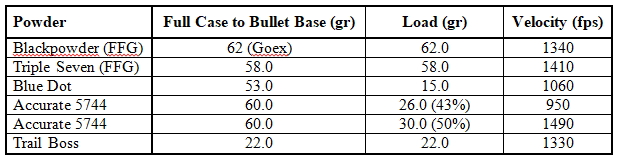
Shooting a 43 Mauser as an example, illustrates the differences that are obtained with these options. These were all fired from a M71/84 rifle with a 31 ½” barrel using a 346 gr lead, flat base bullet. The typical military load was a 386 gr bullet atop 77 gr of blackpowder for 1430 fps (COTW). With solid head cases, the capacity is reduced and without compression, the maximum charge was 62 gr (weighed) for Bertram brass.
The blackpowder had a waxpaper wad above and below the lube wafer. All the other ones were loaded with powder only, including Triple 7. All of the loads below are weighed and are NOT based on volume.
Blackpowder
This is a safe and proven type of load for older cartridges but cleaning the gun and brass needs to be done quickly. Also, the amount of fouling limits the number of shots before accuracy falls off, which means that any extended shooting session is also a cleaning session. Once the blackpowder fouling is removed, from the barrel, the lube residue should be cleaned using a nitro powder solvent, before oiling and storage. The cases need to be cleaned quickly (hot soapy water) or the staining will be almost impossible to remove. With Hodgson shutting down Goex blackpowder production, availability is not what it used to be.
Using a full case of blackpowder the velocity averaged 1340 fps and when the load was reduced to 59 gr, the velocity was 1270, a relatively small change. It might have been possible to settle more blackpowder into the case but there was no chance that it would reach the 77 gr listed in COTW.
Triple Seven
Water clean-up makes Triple 7 a viable option for blackpowder cartridges and the lack of sulphur means that it is much less corrosive than either blackpowder or Pyrodex. While it is meant to be a blackpowder replacement, the general consensus is that it provides around 15% higher velocities for a given volume. In this test, slightly more than 5% velocity was gained over blackpowder when the Triple 7 was added to just avoid compression.
Hodgson recommends, “Triple Seven In Cartridges: Use data specifically developed for Triple Seven FFG only. Cartridge loads should be used exactly as listed in this pamphlet. You may safely use a card or polyethylene wad up to .030″ in thickness to protect the base of the bullet. Loading density should be 100% with light compression not to exceed .100″. Testing has shown that Triple Seven will perform best when the bullet just touches the powder. Allow no airspace between the base of the bullet and the powder. Do not reduce loads by means of filler wads or inert filler material such as Grits, Dacron or Grex. Do not heavily compress powder charges. The use of filler wads, inert fillers or heavy compression may cause a dangerous situation, which could cause injury and/or death to the shooter, bystanders or damage property.”
It is definitely easier to clean than blackpowder and provided a modest increase in velocity. The amount of smoke was perhaps less but it closely mimicked blackpowder. As an aside, the cases should be rinsed in hot water, air dried and then tumbled to keep them looking their best. The lack of sulphur is a definite advantage.
Accurate 5744
This was originally a military surplus powder but for several years now, it is newly manufactured in Canada. Its big selling point was ready ignition and clean burning even in reduced loads. Clean-up is simple – just treat it like any other smokeless powder, which means that you do not need to be in a rush to clean your rifle or the cases.
While normal large rifle primers work well, I have found using magnum primers tends to bring down the extreme spread (or SD) but group size seems to stay about the same. The other advantage of this powder is that the amount used is low, so a pound goes further.
With Accurate 5744 the recommendation from Accurate Powder (before they were bought by Hodgson) was for any cast bullet in a rifle:
i) First determine where the base of your bullet will be seated in the cartridge.
ii) Fill the cartridge to this point with 5744.
iii) Weigh the total powder in grains
iv) Multiply by 0.4 and this total will give you 40% case capacity and a safe reduced load.
In the previous table, at the 40% mark, there were unburned granules and the velocity was uniform but low. Going from 26 gr (43%) to 30 gr (50%), resulted in a considerable jump in velocity and the unburned granules were gone. It also provided a higher velocity than either blackpowder (+11%) or Triple 7 (+6%), so this is likely a maximum load.
Higginson Powders now carries this powder, although it goes in and out of stock.
Blue Dot
The traditional way of loading a lot of large volume, low pressure cartridges was to use some type of shotgun powder. This allowed you to get the velocities you want, at safe pressures and typically ignition was pretty good. Furthermore shotgun powders are meant to burn cleanly at pressures that are only a fraction of what rifle powders are designed for. However, when a case is <30% full, the position of the powder, even for ones that are easy to ignite can have a significant impact on velocity uniformity. While using wadding (tissue) is not always needed in some cartridges it is the best way to go in very large volume ones (e.g. 577 Snider), combined with storing the cases bullet up until they are shot.
With the 43 Mauser, no wadding was used and Blue Dot burned cleanly and while the velocity was a bit low, the fouling was nil and the standard deviation was 11 fps. This load shot to the same point of impact as blackpowder and it makes a great reduced load.
While others will have their favorites, Blue Dot, which is the slowest in the family seems to combine a number of advantages, including fairly good availability. As a general rule, using a magnum primer helps ensure consistent ignition.
As for other smokeless powders, clean-up is simple and there is no need to rush to clean either the rifle or the cases.
Trail Boss
This powder is the clear winner. Easy clean-up, minimal smoke and velocities that closely match blackpowder. 22 gr of Trail Boss, just touched the base of the bullet, which makes over-charging the case impossible. Best of all, this load matched the blackpowder load. Cutting the charge to 21 gr lowered the velocity to 1300 fps and both loads had standard deviations of 11/10 fps, respectively.
Summary
Whether you prefer the authentic experience of shooting blackpowder or the ease of smokeless powder loads, there are a number of options that can be used to keep your older rifles shooting.
NOTE: The loads mentioned here were safe in my rifle but they are provided for informational purposes only, since we have no control over your loading techniques or the condition of your rifle. Similarly, the velocities were measured using a Labradar unit and depending on your barrel length and condition, as well as the chronograph used, you may obtain different results.