
It is funny how little things change over the years. The Swiss 1869/71 Vetterli rifle would have driven fringe groups like PolySeSouvient crazy in its day (fortunately fringe groups and/or Liberals did not exist in this more pragmatic time)!
The Vetterli was the assault rifle of its time, featuring an intermediate power cartridge comparable to the 7.62 x 39 Soviet round, all the while sporting a high capacity magazine (12 rounds). Not only this, but a bayonet could be mounted – imagine the horror that whackadoodles like Nathalie Provost would have proclaimed, if they had been around to see this rifle delivered into hands of citizens in the 1800s? Even today, given the gun ban crowd who run the Liberal Party, it is surprising that they have not directed the RCMP to fabricate some justification for banning it.
This rifle was, in many ways, ahead of its time with a chambering that produced an energy level comparable to current intermediate cartridges, rather than contemporary cartridges adopted by other nations, such as the 577/450 Martini-Henry. The 41 Swiss is a rimfire round but make no mistake, it is not a 22. The table below compares it to some other intermediate rounds as well as the 22 LR.
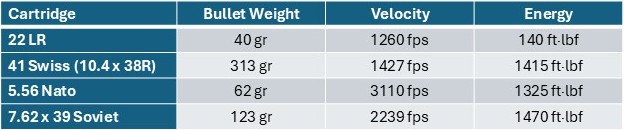
While much less powerful than full-power rounds, what time has shown is that for individual soldiers, these more powerful rounds were never needed.
A large number of the Swiss 1869/71 have been sold in Canada and while it is still possible to find UMC/Remington ammunition, it is priced as a collector item and combined with its age means that reliability is not what it was in the past. The options are to set the rifle on the wall or be creative and get it back on the firing line.
There are numerous videos on the internet showing how this rimfire can be easily converted to centrefire. The decision to do this yourself or rely on a gunsmith is a personal choice however, it is not a difficult conversion to do. Best of all, once the rifle is set up for centrefire ammunition feeding it becomes quite easy.
Having a sound Vetterli, I decided that it would be a great project and the first step was to have the rifle converted. Jason Spencer (Gunco in Nepean) is a first rate gunsmith and he did the work in short order and for a very modest price.
Making the brass is easy since it is possible to use either readily available 348 Winchester or less common 8mm Lebel brass as the starting point. The next table compares the two options. The information for the 41 Swiss came from UMC and Remington cases in my reference collection.

If the 348 Winchester is used, the base needs to be turned down just slightly to get it to chamber. This is not needed for the 8mm Lebel but it is less readily available, while the .348 Winchester is easier to source. Depending on what is available and the cost, either of these can be used.
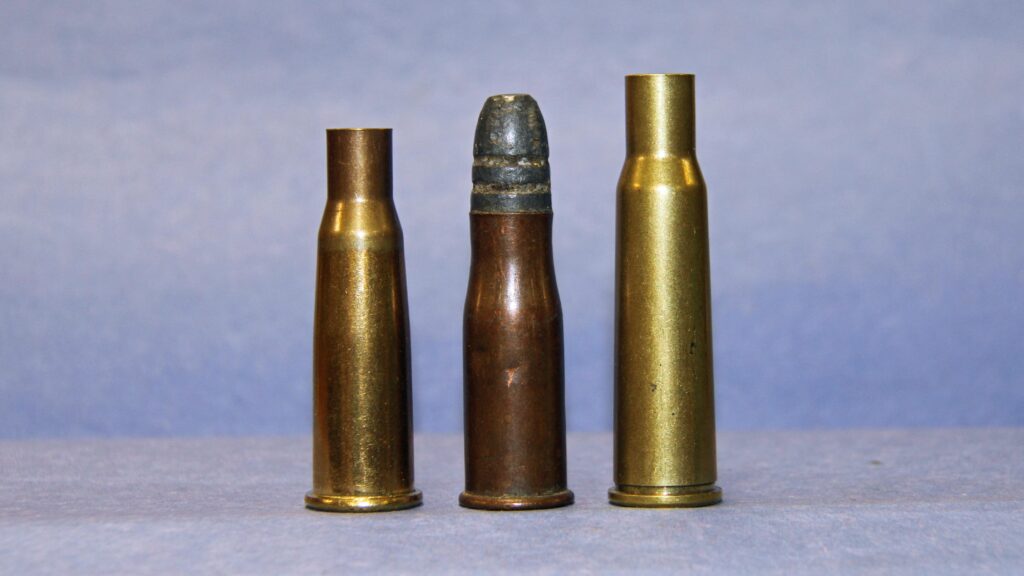
8mm Lebel; UMC factory 10.4 x 38R Swiss (41 Swiss); .348 Winchester
The actual conversion process is quite simple for either starting case:
- Trim the case to around 1.6”
- Anneal the neck (optional but strongly recommended)
- Run through a full length sizing die
- Trim to 1.55” (although the final length is 1.50”) – when fireformed the case will shorten slightly.
If 348 Winchester brass is being used, the base needs to be turned to down about 0.008 – 0.010” and this extends up about an eighth of an inch from the base – basically the area on the case that is not touched by the sizing die. Since this is the web area, there is lots of metal there and this is not a high pressure cartridge, so case life is quite good. While this is simple with a small lathe, the 8mm Lebel case avoids the need to do this, provided you can find the cases. While cases from the .348 Win function well in my Vetterli, the Lebel’s larger rim is closer to the 41 Swiss’ dimensions, which may make a difference for some rifles.
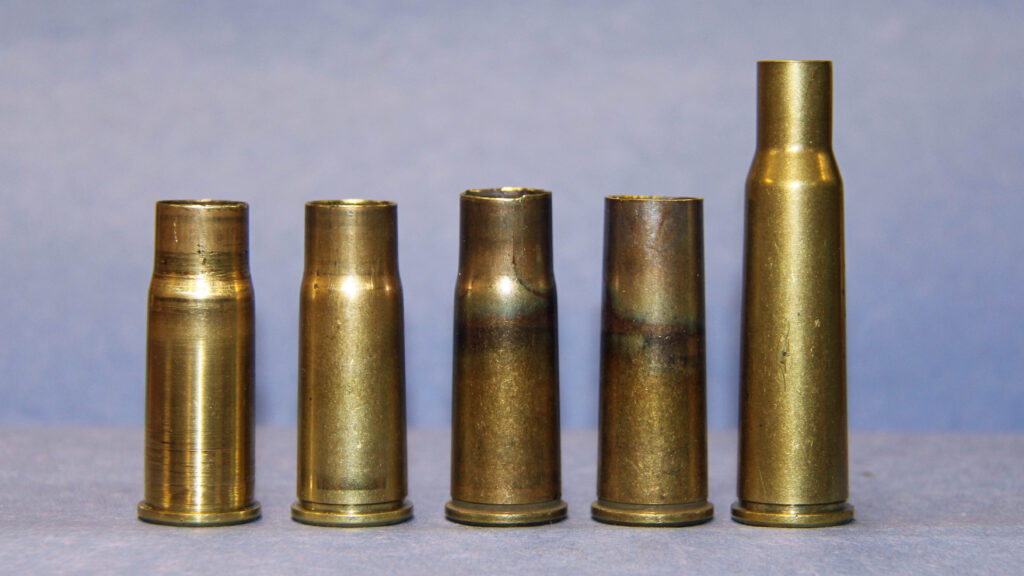
(right to left) .348 Win parent case; roughly trimmed to 1.6”and annealed; after sizing die; trimmed to 1.55”; based turned down to 0.539”
Once the cases are trimmed to length, they can be fireformed and trimmed to the final length of 1.5”, although this is only important if a heel bullet will be used and crimped.
Fireforming can be done using a fast burning powder and filling the case with cream of wheat. This process is widely detailed, so it will not be covered here. However, I prefer to load the cases with normal bullets and form them that way.
There are two available bullets that can be used to load ammunition and each comes with its own unique characteristics.
As I discovered, the bullets from the Lee mould are not gripped by the case neck, even though a Lee sizing die was used. However, the neck expander that came with the die set worked perfectly with the heel bullet. The expander in the Lee sizing die measured 0.427” and the Lee bullet (unsized) was 0.420”. In order to obtain a firm grip on the bullet a second expander stem was obtained and turned down 0.420”. This provided enough neck tension on the Lee bullet that when combined with the crimp die the bullet was firmly held. It might have been better to reduce the expander to 0.418 – 0.419” but 0.420” allowed easy seating of the bullet.
What this meant was that a different expander had to be used for the two different bullets. Higginson Powders has spare expanders for the 41 Swiss in stock, so getting one was easy and reducing the diameter is simple.

The example of a factory (commercial load) had an overall length of 2.15” and the nominal COL for the military load was 2.20”. The commercial bullet (heel style) diameter measured between 0.426 – 0.431” depending on the round checked. Both bullets fed through the rifle’s magazine.
One of the enduring stories is how round nose bullets can set off primers in tubular magazines. Aside from the fact that the 41 Swiss has a very modest recoil, the original military loads for the 8x60R Krop and 43 Mauser (don’t forget the 30-30 and 32 Win Spl) had round nose bullets and tubular magazines. A heavy recoiling round or a pointed bullet may be an issue but that is about it.
For the smokeless powders the bullets were lubed with Lyman Alox but for Triple 7 and blackpowder (FFG) a soft beeswax based lube was used. Out of the seven powders tested, Blackpowder and Triple 7 were the dirtiest and all the other ones showed varying degrees of residue but were much cleaner. On a positive note, Triple 7 did produce a satisfying amount of smoke as each round was fired and a full case provided close to the original velocity.
The blackpowder velocity was low compared to literature references but, there again the case was not going to hold the 62 gr that was used in the original military load. Both 348 Win and 8 mm Lebel are much more heavily constructed in the head area and this reduces the available volume. It might have been possible to add a couple grains more FFG but, not 20 more. It should be noted that all the loads below are weighed.

Note that these loads gave no signs of excess pressure in my rifle and the velocities were around factory original loads (313 gr bullet @ 1427 fps). However, that does not mean they are safe in your rifle and their use is solely at your own risk. Brass was converted 348 Win and CCI 200 primers.
In my rifle, the Lee bullet was under-sized for the bore and there was noticeable lead fouling after only 20 rounds, with the smokeless loads. The most likely reason was that since there was not a good seal, enough gas leaked by to result in gas-cutting. This is also consistent with the lower velocities obtained with the Lee bullet for BH209, IMR4227, 5744 and Blue Dot. Blackpowder and Triple 7 seemed to provide enough of a “bump” to the bullet to seal the bore and avoid leading.
The heel bullet, being larger, sealed the bore better than the smaller diameter Lee slug and this likely also provided more pressure to aid in the combustion of the smokeless powders. As expected blackpowder, Triple 7 and Trail Boss turned in the same velocities with either bullet. Unlike some other older cases, the 41 Swiss case volume is quite modest and even modern smokeless powders fill most of the case, which will aid to promote good combustion.

With the heel bullet, all of these powders ignited and fired perfectly using just regular LR primers (CCI 200). While there were no ignition problems with the Lee bullet, there definitely were more unburned granules present.
Accuracy was typically around 2” at 50 yards although there were some exceptions. Trail Boss and BH 209 shot beautiful 1” groups with the Lee bullet. Using the heel bullet, Trail Boss went just over 1” and 5744 was a close second at 1.5”. It should be noted, that typical for this era, at 50 yds, the groups were 10 – 14” above the point of aim, regardless of the powder or bullet used. The sights on the Vetterli are meant for younger eyes but in spite of this the rifle is quite accurate and 2 – 3” groups at 100 yards is not unrealistic.
Once again the two favorites that stood out were Trail Boss which gave mild velocities and easy loading (just fill the case to the shoulder) and 5744 which easily provided blackpowder velocities with none of the mess. Blue Dot did a good job of igniting and matching original factory loads, although the case was only half full. IMR 4227 was disappointing in my testing (lots of granules left) and I would use it only if that was the only choice, although with the heel bullet it worked better.
Ultimately the choice of powder will be decided on what one can get or already has.
In picking a powder to use, it is a function both of what is available and the cost. Trail Boss has not been available for almost 5 years and a semi-replacement for it, Blackhorn 209 sells for around $150/8 oz, so it is an extremely expensive choice, although it works well. In addition, BH 209 loading information from Hodgson is rather spotty for this Canadian manufactured powder (it is made just outside of Montreal). On the flip side, since it is a nitrocellulose based powder, clean-up is easy
Some final observations were that while the inside lubricated Lee bullet was the more modern design and produced reasonable groups, it is sensitive to bore diameter and powder type. Also, it was more satisfying loading a heel bullet of the type used in period ammunition. A separate crimping step and the need to manually lubricate the bullet increased the loading time but shooting the rifle was not a high volume activity. Part of the pleasure of shooting these older guns it the time it takes to make the ammunition.
Getting your Vetterli out on the range again is not as easy as shooting a .223 but there is a lot of enjoyment getting another gun shooting again. Also perhaps there is a measure of satisfaction of thumbing our noses at the anti-gun lunatics by bringing this 19th century assault rifle back to life.
Reloading Resources
Reloading the 41 Swiss is easier than most since the components are readily available.
Higginson Powders (https://www.higginsonpowders.com) can supply powder, Lee reloading dies and the Lee bullet mould.
Beaks and Brass can supply 348 Winchester brass and heel bullets.