

What are the options for when blackpowder is not what I want to use? There are a number of alternative propellants that can be used.
Blackpowder Alternatives
It was not that long ago, that you could walk into pretty much any gun store and pick up whatever type of propellant you wanted, whether it was smokeless, blackpowder or some blackpowder alternative. It now seems that those days are behind us and it may be a while before we are in that situation again.
In this article we will discuss blackpowder, the alternatives and review the basic chemistry of these propellants. The starting point is blackpowder or as it is sometimes referred to, gunpowder. Although blackpowder is classified as a low explosive, it has generally been readily available until Hodgson stopped making it in 2022. However, with Estes now bringing back Goex, we still have a North American source. While blackpowder is the classic propellant for obsolete cartridges it does have a number of drawbacks:
i) Fouling – when it burns, a mixture of unburnt carbon and inorganic salts are left in the barrel and cartridge. This fouling affects accuracy and cleaning is messy.
ii) Corrosion – the salts that are left behind are corrosive to steel and brass. Unless things are cleaned within a day, or two, there will be staining of the brass and corrosion of the rifle.
Corrosion in particular is a problem with blackpowder and it is the reason so many older rifles can look good on the outside but have badly damaged bores. In addition, the salts that are formed are hydroscopic, which means that they attract moisture, which increases the corrosion rate and it favors pitting, or localized corrosion. A pitted bore is harder to get to shoot well and in many cases accumulates fouling, both powder residue and lead, at an accelerated rate.
Alternatives to blackpowder fall into one of two categories:
i) Propellants that mimic the general chemistry of blackpowder while offering lower corrosion potential or easier cleaning.
ii) Those that are organic based, where all or most of the energy is generated from nitrocellulose.
In blackpowder, and others that employ the same chemistry, there are two general components:
i) Oxygen source – this is in the form of an inorganic oxygen donor, such as nitrate or perchlorate.
ii) Fuel – in blackpowder it is sulphur and charcoal that provides the hot, expanding gases that propel the bullet down the barrel. In the alternatives it can be a number of organic materials.
The first successful blackpowder replacement was Pyrodex but, since it arrived there have been a number that have come and gone. There are two general categories of these inorganic propellants and they are summarized in the next table. The first four propellants are blends with separate fuel and oxidants that are mixed together. Whereas the latter two, are organic propellants where they contain their own internal oxidant – in the same way as smokeless powders.
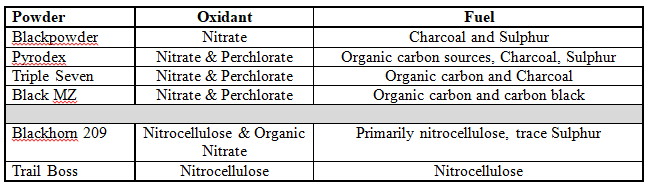
Nitrocellulose is different from the other chemistries since it is both a fuel and an oxygen source combined together. This is why Trail Boss and Blackhorn 209 have virtually nothing else present.
Depending upon the alternative there are several differences compared to blackpowder:
i) If they are sulphur free, then corrosive sulphates are not formed (lower corrosion potential) but the characteristic blackpowder smell is missing.
ii) Lower fouling potential and in the case of ones that are mainly nitrocellulose, extremely easy clean-up and less smoke.
iii) Blackpowder is still the best option for flintlocks due to its ease of ignition. While the alternatives are less easily ignited, the advantage is that they are safer to handle.
The next table contains some specific information on each of the products.
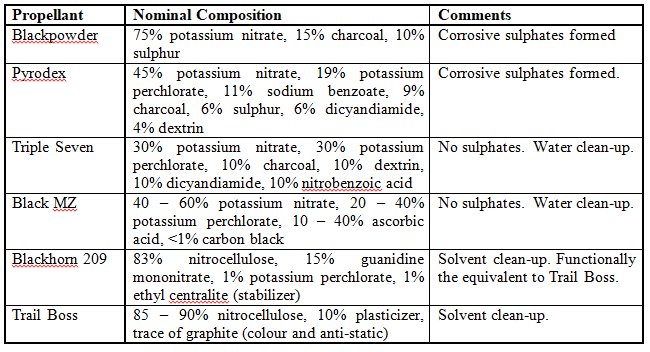
Looking at the list of ingredients it seems like it is a complicated mixture of exotic chemicals but in reality it is a combination of oxygen sources, fuels and a few compounds that are partway in between those two categories.
Nitrate and perchlorate are oxygen donors that are used to provide enough oxygen in the blend to allow the fuel to completely burn. Some of the chemicals such as nitrobenzoic acid contain some of the oxygen they need to burn (nitro = organic nitrate) and the same applies to guanidine mononitrate, which is used as a fuel in explosive mixtures. Other components such as dextrin (a type of sugar) or ascorbic acid (vitamin C) are fuels that serve the same purpose as charcoal and sulphur in blackpower. They are meant to burn and be converted into hot, expanding gases.
Blackhorn 209 or Trail Boss are functionally very similar in that they are mostly nitrocellulose. Regular smokeless powders such as IMR 3031 are quite dense (around 860 g/L), while Trail Boss is 325 g/L, so the amount of energy per volume of propellant is less. IMR 3031 is only nitrocellulose (plus coatings to affect the burn rate) and that is what provides its energy. So the difference between Trail Boss and a single base powder like IMR 3031 is just the amount of energy stored in a given volume of powder. It should be noted that Blackhorn 209 is more energetic than Trail Boss on a given volume basis. So while the chemistry is similar the energy output is different.
Cleaning up after nitrocellulose powders is no different than for your hunting rifle and regular powder solvents can be used.
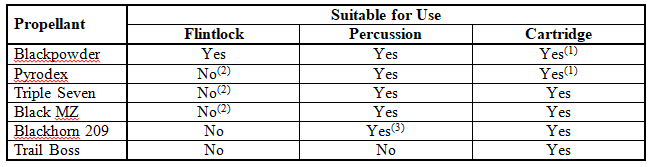
(1) Case needs to be cleaned immediately to prevent tarnishing/corrosion
(2) It can work with a pre-charge of blackpowder and blackpowder in the pan
(3) With in-line rifles and 209 primers
In summary, we have a number of different products that mimic traditional blackpowder in terms of how they are used and the general chemistry approach. In addition, we have two products (Trail Boss and Blackhorn 209) that share more in common with traditional single base (nitrocellulose only) smokeless powders. The choice of which one(s) to use is dictated more by availability and end-use than anything else.